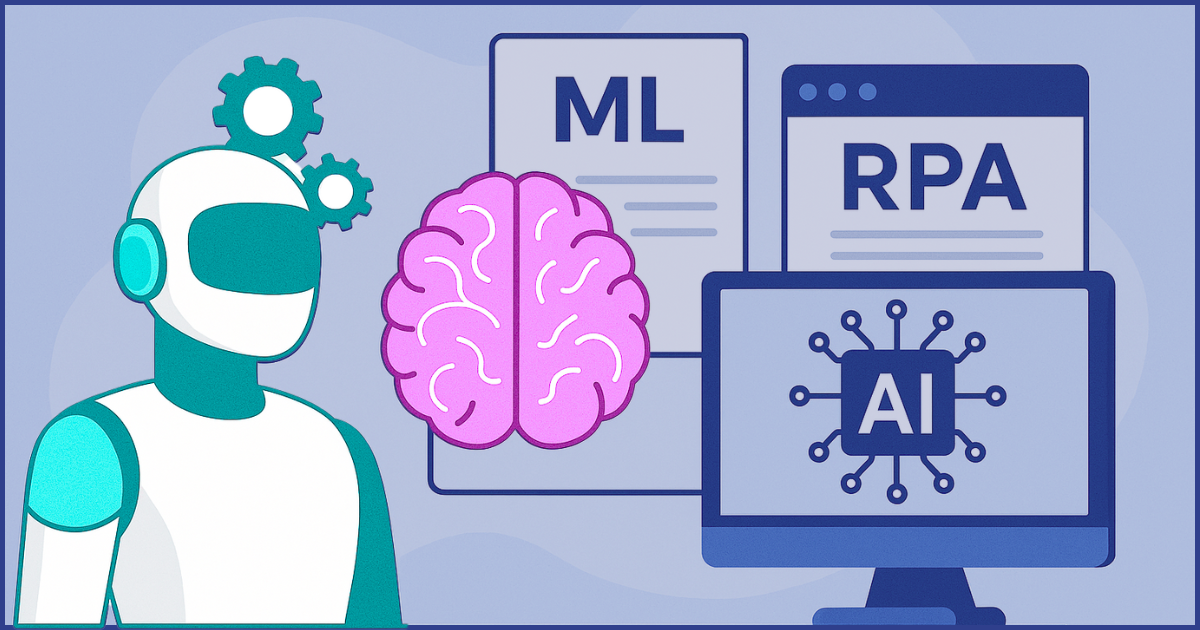


What’s the Difference Between AI, RPA, and Machine Learning?
Ever feel like tech terms are being thrown at you faster than you can Google them?You’re not alone. AI, RPA, Machine Learning, they’re used...
3 min read
Shane Naugher
:
Feb 25, 2026 9:51:44 AM
If your revenue doubled tomorrow, would your systems keep up?
Or would your team be buried in manual processes, chasing invoices, updating spreadsheets, and reacting to problems all day?
Most growing companies don’t hit a ceiling because of lack of demand.
They hit it because their business automation hasn’t matured.
The real question isn’t whether you’re using automation.
It’s whether your automation systems are actually built to scale.
Let’s talk about what that looks like.
This is where most businesses begin.
Your processes rely on people remembering steps. Accounting is manual. Invoice approvals happen over email. Customer inquiries are routed by whoever sees them first.
Nothing is technically “broken.”
But everything depends on human effort.
Growth at this stage means adding more people.
More payroll. More management. More room for error.
And eventually, more complexity than your systems can handle.
At this stage, you’ve started implementing tools.
Maybe you’ve introduced:
Things improve. Tasks move faster. Errors decrease.
But here’s what usually happens next.
Your automation platform doesn’t fully connect across departments.
Marketing runs separately from operations. Finance has its own workflows. Your contact center automation might improve response times, but reporting still requires manual compilation.
You’ve automated tasks.
You haven’t automated the business.
This is where many companies stall.
Now things begin to shift.
Your systems communicate. Data flows between departments automatically. Onboarding triggers downstream workflows. Invoice automation connects directly to accounting automation. Reporting pulls from live system data. This is where automation stops being helpful and starts being strategic.
You gain visibility.
You reduce operational drag.
You stop hiring just to manage workload.
Whether it’s manufacturing automation, service operations, or contact center automation, your workflows become engineered, not improvised.
But there’s still another leap forward.
Because connected systems follow rules.
Intelligent systems support decisions.
This is where AI integrates into your automation systems in a meaningful way.
Not as a novelty.
As infrastructure.
Imagine:
Customer inquiries automatically categorized and routed by urgency. Leads scored based on buying intent. Financial anomalies flagged before they become problems. Operational bottlenecks predicted before they slow production.
Now your automation isn’t just executing.
It’s assisting.
This is where businesses start outperforming competitors who are still stuck in basic automation.
And it’s where engineered automation becomes a real competitive advantage.
Very few small and mid-sized businesses have reached this level, yet.
Here, your business automation becomes proactive.
Systems forecast demand. Customer churn risks are flagged early. Resource allocation adjusts dynamically. Decision-makers receive insights automatically.
Instead of reacting to issues, your business anticipates them.
Growth feels controlled instead of chaotic.
Scaling feels intentional instead of stressful.
This is what mature automation systems are designed to do.
Here’s the uncomfortable truth.
Most companies believe they’re operating at Stage 3.
In reality, they’re at Stage 2 with better software.
They’ve invested in tools, but not in integration, strategy, or long-term automation architecture.
And without that foundation, growth will eventually strain the system.
The companies pulling ahead in 2026 aren’t necessarily bigger.
They’re more mature in how they approach business automation.
You don’t start by buying another automation platform.
You start by stepping back.
You assess your current systems.
You identify operational friction.
You prioritize high-impact automation opportunities.
You integrate intentionally.
Then you layer in intelligent automation where it drives measurable ROI.
It’s progression, not disruption.
If you’re unsure whether your systems could support aggressive growth…
If hiring feels like your only scaling strategy…
If reporting still requires manual effort…
If your automation tools feel disconnected…
It may be time for a structured evaluation.
At Innovative Automations, we help businesses assess their automation maturity, design a clear roadmap, and implement scalable automation systems that actually support growth.
No unnecessary complexity.
No overengineering.
No hype.
Just strategic, measurable progress.
Book a call with a senior automation strategist today.
We’ll evaluate your current business automation systems, identify high-impact opportunities, and map out the next stage of your automation maturity.
Because scaling shouldn’t feel chaotic.
It should feel engineered.
And the right automation strategy makes that possible.
Ever feel like tech terms are being thrown at you faster than you can Google them?You’re not alone. AI, RPA, Machine Learning, they’re used...
2 min read
For weeks, I’ve been hinting at a big announcement, and the day is finally here! Today, I am thrilled to introduce Innovative Automations, a new...
Spoiler: Probably more than you think. Let’s play a quick game—think about your last workweek. How much time did you or your team spend on...